Blog

Top 5 Challenges of AR Automation and How to Solve Them

Introduction  In today’s fast-paced business landscape, Accounts Receivable (AR) automation is no longer a “nice-to-have”, it’s a competitive necessity. By streamlining invoice generation, payment tracking, and collections, automation promises faster cash inflow, fewer manual errors, and better customer experiences. For finance teams, it’s a powerful way to free up time for more strategic work rather […]

Croatia’s New Fiscalization Law: Transition to Digital Tax Processes Projekt Fiskalizacija 2.0 / eRačun

Croatia New Fiscalization Law Fiskalizacija 2.0 eRačun

Croatia’s New Fiscalization Law: Transition to Digital Tax Processes Projekt Fiskalizacija 2.0 / eRačun Introduction  Croatia is taking significant steps toward improving the efficiency of its tax inspection processes in the digital world. Starting in 2025, mandatory e-invoicing and e-reporting systems for businesses will mark a major shift in the country’s tax processes. These new regulations will ensure that commerce becomes more transparent, faster, and traceable, making it easier for businesses to meet their tax obligations.  The E-Fiscalization Process in Croatia Croatia began implementing e-invoicing in 2019 for transactions with the public sector (B2G). This move allowed the tax administration to verify transactions faster and more efficiently in the digital space. By 2025, this system will expand to include business-to-business (B2B) and business-to-consumer (B2C) transactions, marking a significant digital transformation in the country’s tax reporting.  At the heart of this transformation is the new Fiscalization Law, which was approved on June 13, 2025, and will take effect on September 1, 2025. Known as

What is e-invoicing and why is it becoming mandatory in Belgium?

What is e-invoicing and why is it becoming mandatory in Belgium

What is e-invoicing and why is it becoming mandatory in Belgium? What is e-invoicing, and why is it becoming mandatory in Belgium? Belgium is moving quickly towards digital invoicing. As of January 1, 2026, e-invoicing will become mandatory for B2B transactions. But what exactly does that mean? And what should companies do to stay compliant? In this

What is PINT? The Next Generation of Peppol Billing

What is PINT

What is PINT? The Next Generation of Peppol Billing What is PINT? Peppol e-invoicing continues to transform the way businesses exchange invoices across borders. With global adoption growing, there is a strong need for a harmonised, future-ready standard that reduces complexity and supports seamless interoperability. That standard is PINT (Peppol International Invoice). PINT has been developed by

E-Invoicing in Denmark: Everything Businesses Need to Know

Denmark e-invoicing

E-Invoicing in Denmark: Everything Businesses Need to Know Denmark e-invoicing Denmark has been a pioneer in electronic invoicing for nearly two decades. Since 2005, public sector suppliers have been required to send their invoices digitally through the national NemHandel platform. With the adoption of the Danish Bookkeeping Act, these requirements are expanding to include private

Serbia’s 2026 e-Delivery Mandate for Excise Goods: What Businesses Must Know

Serbia’s 2026 e-Delivery Mandate for Excise Goods- What Businesses Must Know

Serbia’s 2026 e-Delivery Mandate for Excise Goods: What Businesses Must Know Serbia’s 2026 e-Delivery Mandate for Excise Goods From January 1, 2026, Serbia will require all B2B transactions involving excise goods to be reported through a centralized e-Delivery system. Learn what this means for manufacturers, importers, and distributors. Introduction: A Major Step Toward Digitalization in Serbia

Croatia’s Fiscalization 2.0: A New Era of Mandatory E-Invoicing Starting 2026

Croatia’s Fiscalization 2.0- A New Era of Mandatory E-Invoicing Starting 2026

Croatia’s Fiscalization 2.0: A New Era of Mandatory E-Invoicing Starting 2026 Croatia e-invoicing process 2026 Croatia is stepping into the future of tax compliance with its Fiscalization 2.0 reform, set to take effect on January 1, 2026. This reform will require all businesses to switch from paper invoices to electronic invoicing (e-invoicing) for transactions between

e-Delivery in Serbia Becomes Mandatory by 2026: What Every Business Must Know

e-deliveryy

e-Delivery in Serbia Becomes Mandatory by 2026: What Every Business Must Know Serbia e-delivery becomes mandatory from 2026 Serbia is embarking on a significant digital transformation in the logistics and transport sector by introducing a mandatory electronic delivery note system, commonly known as the e-Delivery or E-Transport system. Set to take effect on January 1,

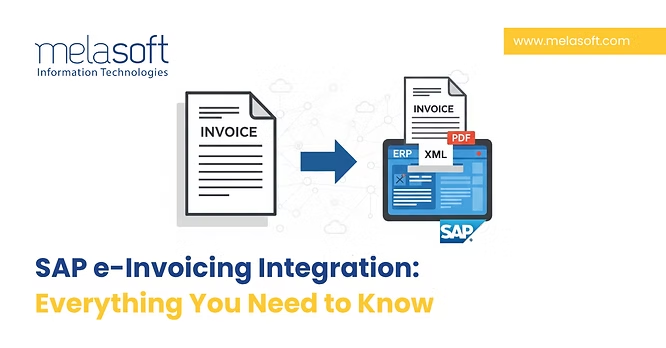
How Do SAP Users Set Up e-Invoicing?

How Do SAP Users Set Up e-Invoicing?

How Do SAP Users Set Up e-Invoicing? What Is e-Invoicing in the Context of SAP? If you’re running your business on SAP, you’ve probably asked this question recently: “How do I connect our SAP system to mandatory e-invoicing requirements?” That question is becoming more urgent by the day. Governments across Europe and beyond are making e-invoicing

Scroll to Top