



Procurement still runs on email and PDFs
Many companies have already digitised their invoices. Yet almost every step before the invoice is still largely manual: product lists circulate in spreadsheets, orders go out by email, and shipments are confirmed by phone.
The result is familiar. Accounts payable teams check every invoice against orders and delivery notes by hand. Price differences, short deliveries and duplicate invoices only surface at that final check. Payments are delayed and supplier relationships suffer.
The problem is not the invoice. It is the road that leads to it, and that is where the solution starts.
What is Procurement Automation?
Procurement Automation brings the seven steps of purchasing together in a single automation layer. Every document flows through Peppol, the international network companies use to exchange e-documents in a standard format. Buyers and suppliers use the same flow on our portal, each sending and receiving the documents for their side.
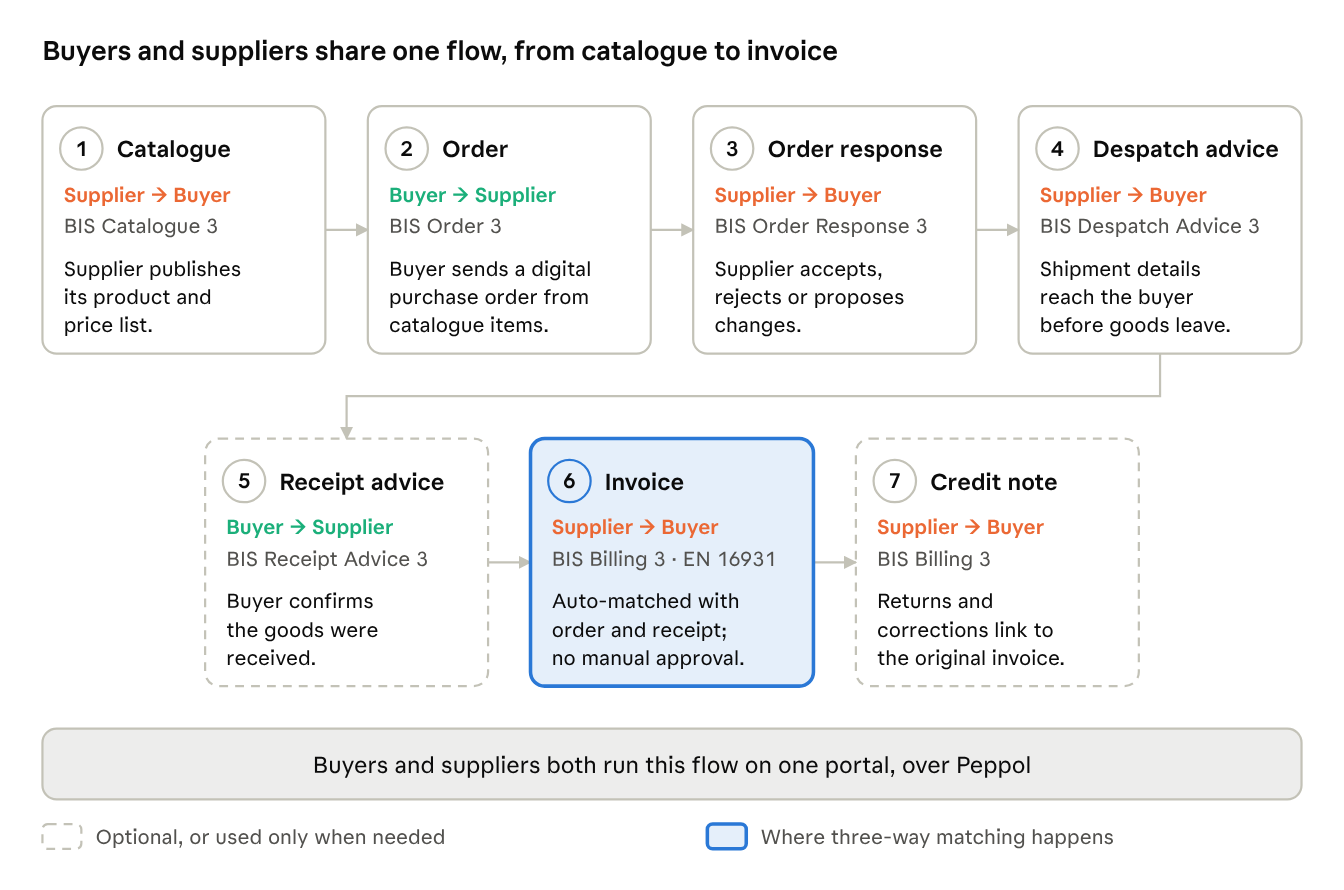
The flow starts with the supplier’s catalogue and closes with the invoice, with a linked credit note where needed. By the time the invoice arrives, the system can check it against the order and the delivery.
Step by step: how it works
Each step reuses the data from the one before it, reducing the need to enter the same information twice.
- Catalogue: The supplier publishes its product and price list in a standard format. The buyer imports it automatically and works with current prices.
- Order: The buyer sends a digital purchase order based on catalogue items. This reduces the risk of wrong item codes and outdated prices.
- Order response: The supplier accepts, rejects or proposes changes to the order. Both sides end up with a clear confirmation.
- Despatch advice: Shipment details reach the buyer ahead of the delivery. The warehouse knows in advance what is arriving and when.
- Receipt advice (optional): The buyer digitally confirms that the goods were received. This is the last checkpoint before the invoice.
- Invoice: The e-invoice arrives and is automatically matched against the order and the receipt. If everything lines up and the configured approval rules allow it, it is approved without manual intervention.
- Credit note (if needed): Returns, corrections and partial refunds are issued as a credit note linked to the original invoice.
At the heart of this flow is three-way matching: what was ordered, what was received and what was invoiced are compared, so matching documents can progress automatically under your approval rules.
What changes for your business
Built for both sides. The same flow serves buyers and suppliers. As a buyer, you import catalogues, send orders and receive auto-matched invoices. As a supplier, you publish catalogues, confirm orders, announce shipments and issue invoices. One portal covers both roles.
Zero-touch approval. Orders, deliveries and invoices are matched automatically. Your team handles the cases that do not match or require review under your internal controls, reducing approval queues.
One integration, every document. You connect to the Peppol network once. Supported documents from catalogue to credit note flow through the same channel, with no separate point-to-point integration per supplier.
A complete audit trail. Every document in the chain is timestamped, archived and traceable. From the first order to the final payment, the records show who approved what, and when.
Compliance built in. The European e-invoicing standard EN 16931 and country-specific formats, such as XRechnung in Germany, Factur-X in France and EHF in Norway, are supported. The required invoice format and delivery route depend on the country and the recipient; not every local format is transmitted unchanged over Peppol.
One solution, global reach. Peppol provides shared document standards across markets, from Norway to Singapore. Multinational companies can reuse a common connection while accounting for local requirements and trading partners’ supported document types.
Why now?
Across Europe, e-invoicing requirements are expanding. Peppol plays an important role in several of these reforms:
| Country | Mandate | Role of Peppol |
|---|---|---|
| Belgium | Structured e-invoicing for in-scope domestic B2B transactions since 1 January 2026, subject to exceptions. | Default network; compliant alternatives require mutual agreement. |
| France | From September 2026, in-scope businesses must receive e-invoices; large and intermediate-sized enterprises must also issue them. SMEs and micro-enterprises follow in September 2027. | Supports interoperability between approved platforms. |
| Germany | Receiving structured e-invoices required since 2025; issuance phased in over 2027–2028 for in-scope domestic B2B transactions, subject to exceptions. | An available delivery channel, including for federal public-sector invoices; not a universal B2B network requirement. |
Companies adopting Peppol for invoicing can use the same infrastructure for supported procurement documents. Set up the right way, a compliance investment becomes an efficiency project across the purchasing process.
Conclusion: from compliance to competitive advantage
The e-invoice is only the last link in the procurement chain. The real gains come when the whole chain, from catalogue to invoice, speaks the same language. Procurement Automation connects that chain end to end over a single Peppol connection.
The outcome: less manual work, fewer errors, more timely payments and records that support audit preparation.
And it works in both directions. On our portal, the same company can act as a buyer, sending orders and receiving invoices, and as a supplier, publishing catalogues, confirming orders and issuing invoices, all within the same flow.
Explore Docnova’s Peppol connectivity and Melasoft SAP e-invoicing integration, or book a demo to discuss your procurement document flow.